


Learn how Shopify’s agentic commerce platform enables merchants to sell through AI conversations, assistants, and autonomous shopping experiences.
On this page
Commerce is entering a new era, one where conversations replace clicks, and AI agents act on behalf of buyers.
In this shift, the question is no longer “How do customers find my website?” but rather:
“How does my business show up inside AI conversations?”
This is where the concept of agentic commerce comes into play – and why Shopify is redefining its role from an eCommerce platform to an agentic commerce infrastructure.
Understanding Agentic Commerce
Agentic commerce refers to a commerce model where AI agents autonomously perform shopping tasks for users. These agents don’t just recommend products – they:
Understand intent
Compare options
Make decisions
Execute purchases
Handle follow-ups
All within a conversation-first experience.
Instead of browsing product pages, users interact with AI like this:
“Find me the best wireless headphones under ₹15,000 and place the order.”
The AI handles discovery, evaluation, and checkout without opening a traditional storefront.
Why This Shift Is Happening Now
Several forces are converging at once:
1. AI Adoption Is Exploding
People are increasingly comfortable asking AI to solve real problems – not just answer questions.
2. Consumers Want Outcomes, Not Interfaces
Users don’t care where they buy. They care that it’s done quickly, correctly, and securely.
3. Commerce Is Becoming Invisible
The best buying experience is one you barely notice – frictionless, contextual, and fast.
Traditional eCommerce systems weren’t built for this reality.
The Limits of Traditional eCommerce
Conventional eCommerce depends on:
Visual browsing
Page navigation
Manual filtering
Multi-step checkout flows
AI agents don’t browse pages.
They consume structured data, real-time APIs, and transaction-ready systems.
Without this foundation, your store is effectively invisible to AI.
How Shopify Enables Agentic Commerce
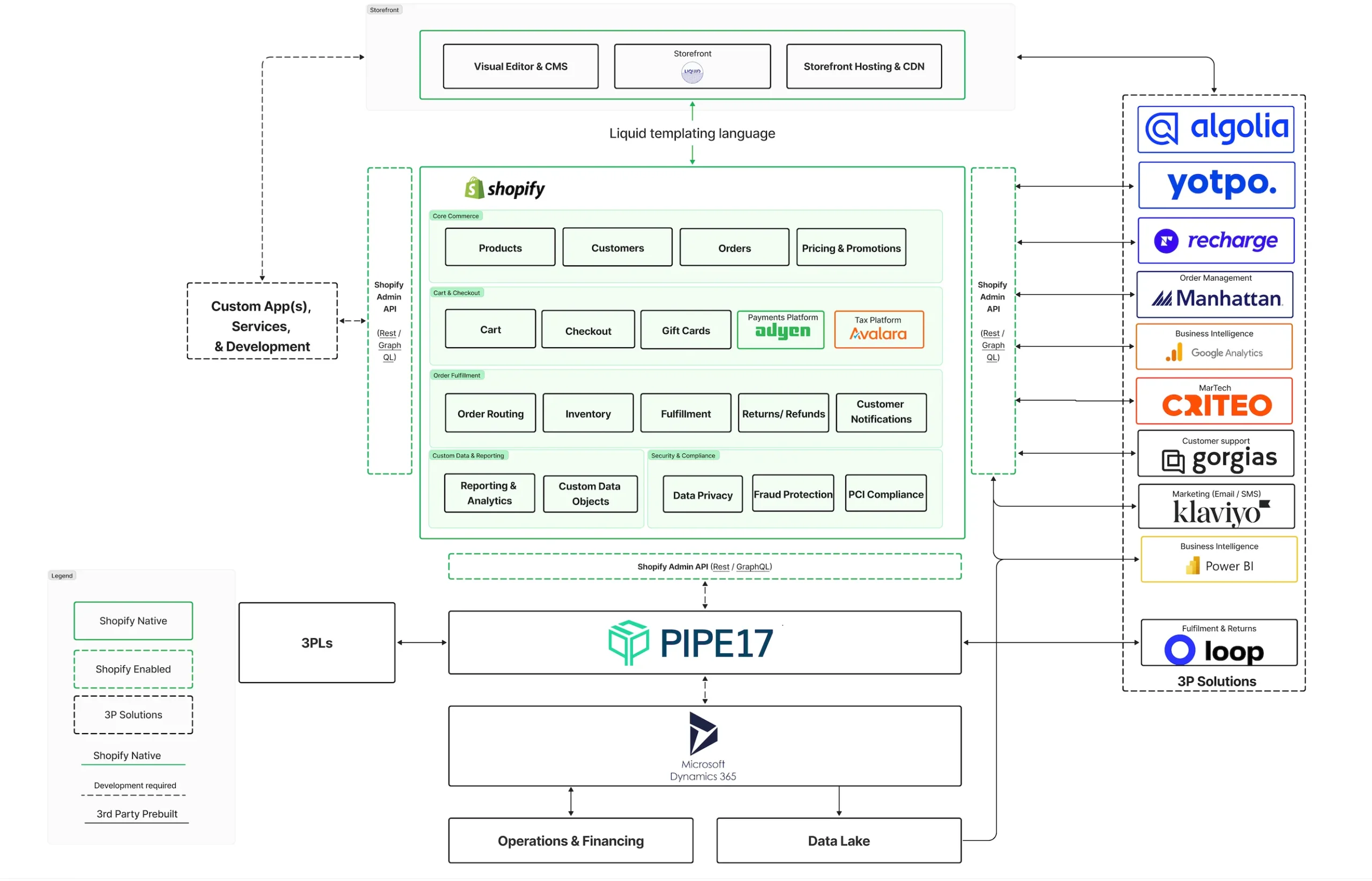
Shopify’s evolution is strategic, not cosmetic. It is transforming into a commerce engine that AI agents can operate.
1. Commerce Exposed as APIs
Shopify treats commerce as a programmable system, not just a storefront.
AI agents can access:
Product catalogs
Pricing logic
Inventory status
Order creation
Payment workflows
This API-first design allows AI systems to interact directly with commerce logic no UI required.
2. Secure, AI-Ready Checkout Infrastructure
One of the biggest challenges in agentic commerce is trust.
Shopify solves this by:
Handling secure payments
Managing compliance
Ensuring fraud protection
Supporting global currencies and tax logic
AI agents can confidently complete purchases because Shopify provides the trusted transaction layer.
3. Headless & Composable by Design
Agentic commerce demands flexibility.
Shopify supports:
Headless frontends
Custom AI interfaces
Conversational UIs
Voice and chat integrations
Your commerce backend stays stable while AI experiences evolve independently.
Where AI Commerce Conversations Happen

Agentic commerce doesn’t live in one channel. It spans:
AI chat assistants
Voice agents
Messaging platforms
Smart devices
Enterprise copilots
Shopify powers the transaction, while AI owns the conversation.
What This Means for Merchants
From Traffic to Intent
You no longer chase visitors – you serve ready-to-buy intent delivered by AI.
From UX Design to Data Design
Success depends on:
Clean product data
Rich attributes
Structured metadata
Real-time availability
From Storefronts to Systems
Your business becomes:
API-driven
AI-readable
Automation-ready
Why Agentic Commerce Is the Future of eCommerce
This isn’t a trend – it’s a structural shift.
AI agents will manage subscriptions
Reorders will happen autonomously
Purchases will be proactive, not reactive
Brands that aren’t agent-ready will simply not be recommended.
How Raulji Technologies Helps Brands Prepare
At Raulji Technologies, we help businesses transition from traditional eCommerce to agentic commerce ecosystems.
Our focus includes:
Shopify headless & API-first architecture
AI-friendly product data modeling
Conversational commerce enablement
Secure, scalable checkout systems
Future-proof commerce strategy
We don’t just build online stores.
We build commerce systems that AI can understand, trust, and operate.
Final Thoughts
The future of commerce won’t be clicked.
It will be spoken, interpreted, and executed by AI agents.
Shopify’s evolution into an agentic commerce platform makes one thing clear:
If your business isn’t connected to AI conversations,
it won’t be part of tomorrow’s commerce.
Now is the time to prepare.
Frequently Asked Questions
Answers to the questions we hear most often.
What is agentic commerce in plain terms?
It is buying that happens inside an AI conversation instead of on a website. The shopper describes what they want, an AI agent handles discovery, comparison and increasingly the checkout itself, and the merchant's product data is what the agent reasons over. The practical consequence for a store owner is that your product feed, not your homepage, becomes the thing being evaluated. A beautifully designed storefront that the agent never sees does not enter the consideration set at all. Treat it as a second storefront that reads rather than looks, and the work becomes obvious: accurate titles, attributes, stock levels and policies.
Which AI surfaces can Shopify merchants actually sell on today?
Shopify lists three as live. ChatGPT is available to millions of merchants selling to US buyers regardless of where the store is based, with the buyer completing purchase on the merchant's own store through an in-app browser. Microsoft Copilot is live for merchants discoverable through Shopify Catalog selling to US buyers, with direct checkout. AI Mode in Google Search and the Gemini app is open to select brands with native checkout, and a broader rollout is underway. Availability changes quickly, so check your admin rather than any article.
What is the difference between UCP and ACP?
They are two competing open standards for the same job. The Universal Commerce Protocol, developed by Shopify and Google, defines how AI agents transact with merchants across cart creation, checkout, payment and post-purchase, on any platform and any payment processor, and is backed by companies including Amazon, Meta, Microsoft, Stripe, Visa, Mastercard, Walmart, Target and Etsy. The Agentic Commerce Protocol, developed by OpenAI and Stripe, handles checkout sessions and secure payment transmission and began as the backbone of ChatGPT's Instant Checkout. Most merchants will end up reachable through both.
Do I need to install an app or build an integration?
On Shopify, generally no. Products syndicate through Agentic Storefronts and Shopify Catalog automatically, with no apps to install, no custom integration, and no transaction fees beyond standard processing rates. When a new AI platform adopts the protocol, eligible merchants become sellable there without doing anything. That is the strategic argument for staying on the platform rather than a bespoke stack: the integration burden of every future AI surface is absorbed for you rather than becoming another project. What you do still owe is data quality, because syndication only ever publishes what your catalogue already says about a product.
Is agentic checkout available to Indian merchants and Indian buyers?
Not yet in the way this article's example implies. The live surfaces are currently gated on selling to US buyers, so an Indian store selling into the US can qualify while an Indian store selling domestically generally cannot buy or check out through these agents today. That is a rollout stage, not a permanent restriction, and the sensible response is preparation rather than waiting: clean product data, accurate pricing and stock, and clear policies are what determines eligibility whenever your market is switched on.
How do agents decide which products to show?
From structured product data rather than marketing copy. Title, attributes, price, availability, shipping, returns and reviews are what an agent can compare, and gaps get you excluded from comparisons you would otherwise win. This is why Shopify Catalog is the centre of the whole system: it is the structured layer that syndicates to every connected platform. The uncomfortable implication is that a store with excellent design and vague product data now performs worse than a plain store with rigorous data.
Is this actually driving meaningful traffic yet?
It is growing fast from a small base. Adobe Analytics reported AI-referred traffic to US retail sites up 138 percent year on year in May 2026 and more than 1,300 percent since October 2024, and found that AI-referred visitors converted 54 percent better than the average visitor. So the volume is still modest against search and paid channels, but the quality is high because the agent has already done the qualifying. Treat it as a channel worth being present in, not one to reallocate your whole budget toward.
Does agentic commerce make SEO irrelevant?
No, it changes what SEO is for. SparkToro's clickstream analysis found that 68.01 percent of US Google searches ended without a click between January and April 2026, up from 60.45 percent in 2024, so the click was already becoming the wrong success metric. What still matters is being the source an AI system draws on: crawlable content, accurate structured data, clear answers to real buying questions, and third party corroboration such as reviews and mentions. That is recognisably SEO work with a different scoreboard.
What happens to my brand relationship if an agent handles the sale?
You lose some of the storefront experience and keep the fulfilment relationship, which is a real trade-off worth deciding deliberately. The customer may never see your homepage, your merchandising or your upsells. What you still control is the product, the packaging, the delivery experience, post-purchase communication and the reason someone asks for you by name next time. Brands that depend heavily on the browsing experience to differentiate should think hard about this rather than enabling everything by default. The decision is per surface rather than all or nothing, so it is worth reviewing again as each new channel opens rather than settling once.
What should a merchant do first to prepare?
Fix the product data before anything else. Complete titles and attributes, accurate real-time pricing and inventory, honest shipping and returns information, and structured data that matches what is actually on the page. Then make sure your policies are machine readable and your reviews are genuine, since agents weigh corroboration heavily. None of this is speculative work: it improves conventional search and conversion at the same time, which is why it is the right first move even if agentic volumes stay small in your market.
Does this only apply to Shopify?
No. Shopify moved early and made it default, but the protocols are open standards with wide backing, and the Agentic Commerce Protocol has been adopted by more than twenty five partners including Adobe Commerce and Salesforce. Magento and other platforms can participate, typically through a feed or an integration rather than automatically. The difference is effort: on Shopify it is largely handled for you, while elsewhere it becomes a project you scope, build and maintain per surface. If you are on Magento, budget for the feed work and the maintenance behind it rather than assuming parity out of the box.
Is it too early to invest in this?
It is early for revenue and not early for readiness, and those need separating. Committing engineering budget to a bespoke agent integration today is speculative for most merchants. Getting product data, structured markup, stock accuracy and policy clarity right is not speculative at all, because it pays off in ordinary search and conversion regardless of what happens next. Do the second now, watch your admin for the first, and revisit when the surfaces open in your market. The readiness half also carries no regret, since none of that work is wasted if agentic buying stays small in your market.


